
Business reports point to a bright future for spray foam. Although there may be a current lull, the industry has nearly doubled in size over the past ten years.
According to Fortune Business Insights, a leading provider of actionable market insights, the spray foam insulation market is projected to experience significant growth in the coming years, reaching an estimated $4.79 billion by 2034 with a compound annual growth rate (CAGR) of 6.6%.
A few years ago, owning a rig might have been a sure thing, and may have been seen as a recession-proof industry. However, the industry is currently experiencing a squeeze that the big reports don’t mention. The gap between the data and daily reality is driven primarily by factors such as the current housing cycle and rising chemical costs.
According to market.us, new construction has slowed because of high interest rates. The spray foam industry relies heavily on new residential builds, so a dip in housing directly affects a contractor’s business.
Furthermore, chemical manufacturers and suppliers are steadily raising prices for isocyanates and polyols, which hits the contractor’s profits and results in higher prices for consumers.
While everyone needs and wants to save money in the long run, selling a premium product to a budget-conscious consumer is tough. Choosing between spray foam and alternatives like fiberglass or cellulose may save thousands upfront but cost more down the road. The contractor should come equipped with data showing the long-term advantages (see more about that below).
On the upside, ongoing research and development has advanced machine design and efficiency, as well as improved plural-component chemical performance. With skilled contractors, manufacturers, and distributors in place, the industry is poised to get over the hump, educate the consumer on the value of spray foam insulation, and reduce environmental impact for decades to come.
Spray Foam Industry By The Numbers
| Global Spray Foam Market | Market Size / Growth |
|---|---|
| 2025 Market Size | USD 2.69 Billion |
| 2026 Market Size | USD 2.87 Billion |
| 2034 Forecast Market Size | USD 4.79 Billion |
| CAGR (2026–2034) | 6.59% |
Source: Fortune Business Insights, Spray Foam Market .
New Developments to Advance the Spray Foam Industry
In 2025, the EPA’s AIM Act legally required chemical manufacturers to transition to fourth-generation hydrofluoroolefin (HFO) blowing agents. The result is an ultra-low GWP (Global Warming Potential) of between 1 and 10, while also delivering slightly better R-value and yield, albeit at a higher price. A three-year grace period for HFC-based material made before January 1, 2025, still allows it to be sold and used.
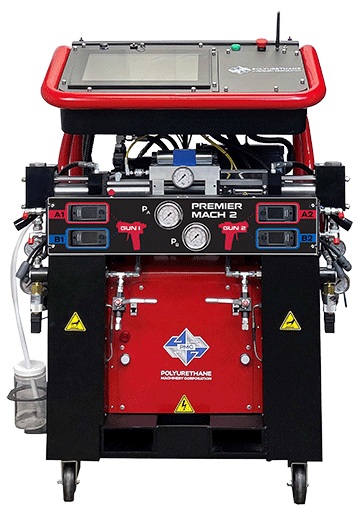
Machine technology needs to meet the demands of a rapidly growing industry. The PMC Premier Mach 2 is the first of its kind: a patent-pending dual-gun proportioner that outputs 40 lbs./minute and supports two size 02 or equivalent chamber spray guns. One machine that does the job of two is a huge cost saving for the contractor and gets the job done twice as fast. Beyond speed and efficiency is the data reporting, recording, and remote-access technology. Innovations like this improve productivity while reducing your carbon footprint. It also provides data that helps you run your business and show the homeowner exactly how efficiently and on-ratio you sprayed.
Are the Advantages Worth the Cost?
Nationally, installing spray foam insulation could cost the consumer between $2 and $7 or more per sprayed square foot. Additional factors such as the type of foam, local labor costs, the project scope, and location could sway the cost well above this estimate. Overall, spray foam insulation costs more to install than conventional fiberglass insulation. However, its advantages pay for themselves over time. To convince a consumer that spray foam is worth the premium price tag, you have to shift the conversation from an upfront expense to a long-term asset.
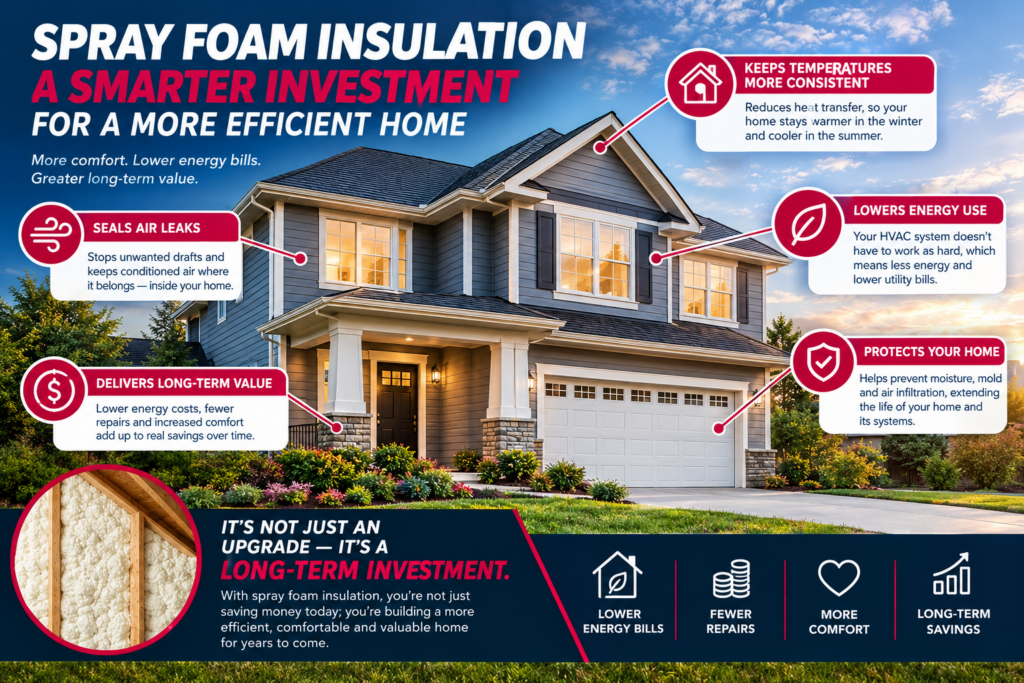
- Standard insulation allows massive air leakage. Spray foam acts as both insulation and an air barrier, reducing monthly heating and cooling bills by up to 15% to 40% right out of the gate.
- Seals in the heat and cool: Spray foam seals a house so tightly that a homeowner can often install a smaller, less expensive HVAC system. These upfront savings on heating and cooling equipment immediately offset a chunk of the spray foam’s premium cost.
- Green Tax Incentives: Remind them that federal incentives (like the 30% Energy Efficient Home Improvement Credit up to $1,200 annually) and local utility rebates put cash back in their pocket during tax season.
- Allergy and Dust Barrier: It stops outdoor allergens, pollen, and dust from bypassing the walls. For families with asthma or allergies, this is a massive quality-of-life upgrade.
- No Nesting Pests: Unlike fiberglass batts or loose cellulose, pests, mice, and insects cannot use spray foam as nesting material or a food source.
- A Quieter Home: Open-cell spray foam is an exceptional sound-dampener. It drastically reduces street traffic noise, airplane overheads, and internal plumbing sounds.
- Moisture and Mold Defense: Closed-cell spray foam rejects liquid water. It prevents the hot/cold air collisions that cause hidden condensation, rot, and mold growth inside wall cavities.
- Racking Strength: Studies show closed-cell foam can increase the racking strength (structural wind resistance) of a home’s walls by up to 200% to 300%, providing extra peace of mind in storm-prone regions.
Waiting Out the Market
Machine technology and chemical formulations will continue to propel the industry forward. Equipment and chemical manufacturers are rising to the challenge by responding to market needs with enhanced performance, efficiency, and product sustainability.
Forecasts show that housing will rebound in 2028. Interest rates will go down but not significantly. Construction volume will only rebound once wages catch up to new pricing baselines and raw material costs stabilize, a process expected to take until early 2028, according to freedommortgage.com
In the meantime, consider focusing on retrofitting existing homes, pursuing commercial jobs, or pivoting to slabjacking to keep spraying.
The spray foam industry is the wave of the future. Adaptation and resilience will win in the end.